W BIKIN CERITA KOMIK ? SEBUAH CERITA KEREN Mount Etna Megatsunami Mediterranean_Sea Paul Shoaway, a Native of the Umatilla tribe in the Columbia Plateau region, 1899
 Ancestor Statue, Jericho, c. 9000 BC (Replica). Israel Museum.[6]
Plastered Skull, Tell es-Sultan, Jericho, c. 9000 BC

Earliest known ceramics are the Gravettian figurines that date to 29,000 to 25,000 BC.

Bronze mirror with a female human figure at the base, Eighteenth dynasty of Egypt (1540–1296 BC)

Sphinx-lion of Thutmose III 1479–1425 BC

Late 3rd Millennium BC silver cup from Marvdasht, Fars, with linear-Elamite inscription.

Dancing girl of Mohenjo-daro, c. 2500 BC (replica).

Gold 'Mask of Agamemnon' produced during the Mycenaean civilization, from Mycenae, Greece, 1550 BC

Bronze Nuragic figurine

Göbekli Tepe animal sculpture, circa 9000 BCE

Female statuette, 8th millenium BCE, Syria

Yamourkian figurines, Yamourkian culture (5500–5000 BCE), Pre-Pottery Neolithic B.

Portrait of an Achaemenid Satrap of Asia Minor (Heraclea, in Bithynia), end of 6th century BCE, probably under Darius I.[34]

The Dying Galatian was a famous statue commissioned some time between 230–220 BC by King Attalos I of Pergamon to honor his victory over the Celtic Galatians in Anatolia.

Russian icon of the Theophany (the baptism of Jesus by John the Baptist) (6 January), the highest-ranked feast which occurs on the fixed cycle of the Eastern Orthodox liturgical calendar.

Genetic settlement of Beringia

Drawing accompanying text in Book XII of the 16th-century Florentine Codex (compiled 1540–1585), showing Nahuas of conquest-era central Mexico suffering from smallpox

Textile art by Julia Pingushat (Inuk, Arviat, Nunavut, Canada), wool, embroidery floss, 1995

Bill Reid's sculpture The Raven and The First Men. The Raven represents the Trickster figure common to many mythologies.

Casting bronze ding-tripods, from the Chinese Tiangong Kaiwu encyclopedia of Song Yingxing, published in 1637.
_02.JPG)
Statuette from Hacilar (5250-5000 BC), National Archaeological Museum (Florence)

Diagram of a replicated and condensed metaphase eukaryotic chromosome. (1) Chromatid – one of the two identical parts of the chromosome after S phase. (2) Centromere – the point where the two chromatids touch. (3) Short arm (p). (4) Long arm (q).

Organization of DNA in a eukaryotic cell

The major structures in DNA compaction: DNA, the nucleosome, the 10 nm "beads-on-a-string" fibre, the 30 nm fibre and the metaphase chromosome.

One of 18 Statues of Gudea, a ruler around 2090 BC JORDI THE KHIDIR

One of the Nimrud ivories shows a lion eating a man. Neo-Assyrian period, 9th to 7th centuries BC.

The Burney Relief, First Babylonian dynasty, around 1800 BC

Alabaster with shell eyes, male worshiper from Eshnunna, 2750–2600 BC

The Babylonian marriage market by the 19th-century painter Edwin Long

Statuette of Standing Nude Goddess, 1st century B.C--1st Century A.D.

Fragment of the Stele of the Vultures showing marching warriors, Early Dynastic III period, 2600–2350 BC

One of two figures of the Ram in a Thicket found in the Royal Cemetery in Ur, 2600–2400 BC

"Pair of Basket-Shaped Hair Ornaments", c. 2000 BC.

Ancient Badarian mortuary figurine of a woman, held at the Louvre

.jpg)

Female figure, c. 3500–3400 B.C.E. Terracotta, painted, 11 1⁄2 in × 5 1⁄2 in × 2 1⁄4 in (29.2 cm × 14.0 cm × 5.7 cm). Brooklyn Museum

Bull palette, Naqada III.

The Terracotta Army (c. 210 BCE) discovered outside the Mausoleum of the First Qin Emperor, now Xi'an

Go is an abstract strategy board game for two players, in which the aim is to surround more territory than the opponent and was invented in China more than 2,500 years ago.

In ancient times berries were crushed by foot in a barrel or pit

The reticulate whipray is one of the species that colonised the Eastern Mediterranean through the Suez Canal as part of the ongoing Lessepsian migration.

Golden Pioneer atop the Oregon State Capitol

Solidus depicting Christ Pantocrator, a common motif on Byzantine coins.
.jpg)

Emperor Justinian (left) and general Belisarius
 Gold solidus of Leo III (left), and his son and heir, Constantine V (right)
 Emperor Basil II (r. 976–1025)

 A mosaic from the Hagia Sophia of Constantinople (modern Istanbul), depicting Mary and Jesus, flanked by John II Komnenos (left) and his wife Irene of Hungary (right), 12th century
 The double-headed imperial eagle, a common Imperial symbol
 Gold coin of Justinian I (527–565 CE) excavated in India probably in the south, an example of Indo-Roman trade during the period
-
 Terracotta stamp seal with Master of Animals motif, Tello, ancient Girsu, End of Ubaid period, Louvre Museum AO14165. Circa 4000 BC.[26][27][28]
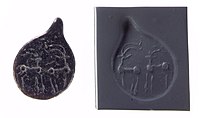 Drop-shaped (tanged) pendant seal and modern impression. Quadrupeds, not entirely reduced to geometric shapes, ca. 4500–3500 BC. Late Ubaid - Middle Gawra periods. Northern Mesopotamia
 Stamp seal and modern impression: horned animal and bird. 6th–5th millennium BC. Northern Syria or southeastern Anatolia. Ubaid period. Metropolitan Museum of Art.
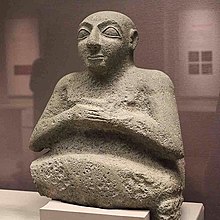 Stone statue of Kurlil, Early Dynastic III, 2500 BC Tell Al-'Ubaid

.jpg)
_pendant_seal_and_modern_impression._Quadrupeds,_ca._4500%E2%80%933500_B.C._Late_Ubaid_-_Middle_Gawra._Northern_Mesopotamia.jpg)


Anthropomorphic Cucuteni–Trypillia clay figurine

A typical Cucuteni–Trypillia clay "goddess" fetish

Classification of Indo-European languages. Red: Extinct languages. White: categories or unattested proto-languages. Left half: centum languages; right half: satem languages
Terracotta Army inside the Qin Shi Huang Mausoleum, 3rd century BC
 70 000 pasukan dajjal ?
The paradise fish is well-known in the aquarium hobby and it originates from East Asian river basins, including the Yellow River

The Chinese pond turtle (shown) and Chinese softshell turtle are both native to the Yellow River, but also farmed in large numbers

The two sturgeon species in the Yangtze (here Chinese sturgeon) are both seriously threatened

The silver carp is native to the river, but has (like other Asian carp) been spread through large parts of the world with aquaculture

The critically endangered Chinese alligator is one of the smallest crocodilians, reaching a maximum length of about 2 m (7 ft)[108]

The entirely aquatic Chinese giant salamander is the world's largest amphibian, reaching up to 1.8 m (5.9 ft) in length[114]

The Chinese mitten crab is a commercially important species in the Yangtze,[121] but invasive in other parts of the world.[122]
.jpg)
Dust storm over Sydney CBD with the Sydney Tower in background (September 2009).
.jpg)
Archibald Fountain in Hyde Park. The fan of water jets represent the rising of the sun.

Unfinished basalt statue of Shalmaneser III. From Assur, Iraq. 858–824 BCE. Ancient Orient Museum, Istanbul

Statue of the god Kidudu, guardian spirit of the wall of the city of Ashur. Circa 835 BC. From Ashur, Iraq. The British Museum, London

Ashurnasipal with official

The sky goddess Nut and human figures representing stars and constellations from the star chart in the tomb of Ramses VI

Sirius (bottom) and Orion (right). The Winter Triangle is formed from the three brightest stars in the northern winter sky: Sirius, Betelgeuse (top right), and Procyon (top left).


A bust of Sopdet, Egyptian goddess of Sirius and the fertility of the Nile, syncretized with Isis and Demeter


Many
religions use images to "represent" God in icons for art or for
worship. Here are some examples of representations of God in Christianity and various branches of Hinduism.
 God blessing the seventh day, a watercolor painting depicting God, by William Blake (1757–1827)
 And Elohim Created Adam by William Blake, c. 1795
Sculpture of the head of Sumerian ruler Gudea, c. 2150 BC

Enthroned Sumerian king of Ur, with attendants. Standard of Ur, c. 2600 BC.
Sumerian princess (c.2150 BC)


Louvre Museum AO 295.
_-_EnKi_(Sumerian).jpg) Akkadian cylinder seal from sometime around 2300 BC or thereabouts depicting the deities Inanna, Utu, Enki, and Isimud
Akkadian cylinder seal from sometime around 2300 BC or thereabouts depicting the deities Inanna, Utu, Enki, and Isimud Fragment of a bas-relief with a seated woman; 2255-2040 BC; steatite; height: 14 cm; Louvre
 From the royal tombs of Ur, made of lapis lazuli and shell, shows peacetime
 Sumero-early Akkadian pantheon
 Sculpture of the ritually nude 'Priest-King', Late Uruk, Louvre.
 Head of a woman discovered at Uruk, the 'Mask of Warka'.
 The earliest wheels were made of a solid piece of wood[citation needed]
.jpg) Solid wheels on a heavy temple car, contrasted with the lighter wire-spoked wheels of the black roadster bicycle in the foreground
Solid wheels on a heavy temple car, contrasted with the lighter wire-spoked wheels of the black roadster bicycle in the foreground The Very Large Array in New Mexico, an example of a radio telescope
 Star cluster Pismis 24 with a nebula
 Shamash (the Babylonian sun god) hands King Hammurabi a code of law
E-abzu temple of Eridu

Mesopotamian female deity seated on a chair, Old-Babylonian fired clay plaque from Ur
 "The Dying Gaul", a Roman marble copy of a Hellenistic work, originally in bronze, of the late 3rd century BCE Capitoline Museums, Rome
 Bas-Relief, late 19th century. Limestone.

The Louvre lion and accompanying stone tablet bearing the earliest known text in Hurrian
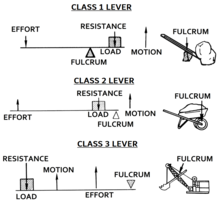
Three classes of levers
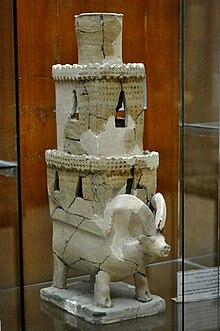
Hurrian incense container
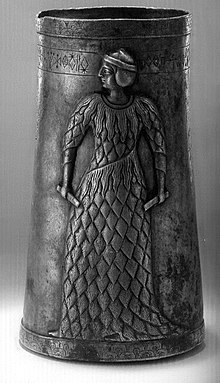
Silver cup from Marvdasht, Iran, with a linear-Elamite inscription from the time of Kutik-Inshushinak. National Museum of Iran The Nike of Samothrace (Winged Victory), marble, c. 190 BC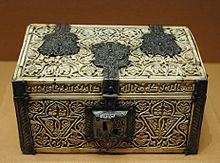
Casket, ivory and silver, Muslim Spain, 966
 Statue, plaster and reed, Ain Ghazal, Jordan, 6050–7050 BC
 Cycladic, a votive head, 2700–2300 BC
 Egyptian, stele, Priest burning incense before Ra-Horakhty-Atum, c. 900 BC

 Ancient Persia, the Ibex Rhyton, 600–300 BC

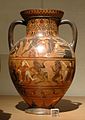 Etruscan amphora, Diomedes and Polyxena, c. 540–530 BC
 Hellenic Near East, The Eros Medallion, c. 250–200 BC
 Fayum Egyptian, Fayum mummy portrait

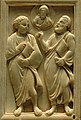 Frankish, ivory, Christ between two apostles, 5th century
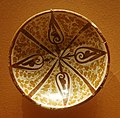 Islamic art from Iraq, terracotta cup, 9th century

 Romanesque architecture from France, St Michael and the Devil, 12th century
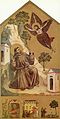

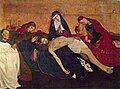

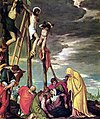




 André-Charles Boulle Cabinet sur piètement, 1690–1710
 André-Charles Boulle Cabinet sur piètement
 André-Charles Boulle, 1700–1720


.png)

.JPG)


.jpg)


.jpg)


_02.jpg)


Comments
Post a Comment