mitology
- Tabiti (Ταβιτί) – Hestia (Tabiti is thought to be a hellenized version of a name similar to Hindu Tapati and related verb tapayati ("burns"/"is hot"), as well as Avestan tapaiti, Latin tepeo and several other Indo-European terms for heat.[3][4]) Tabiti was presented as "Queen of the gods" around 450 BCE by King Idanthyrsos, a political guardian,[5] she was considered the goddess of the home ensuring prosperity to a well-functioning household.[6]
- Scythian Ares (Greek: Ἄρης) – Ares
- Papaios (Παπαῖος) – Zeus
- Api (Ἀπί) – Gaia
- Oitosyros (Οἰτόσυρος) – Apollo
- Argimpasa (Ἀργίμπασα) – Aphrodite Urania
- Thagimasidas (Θαγιμασάδας) – Poseidon
Kök Tengri is the first of primordial deities in the religion of the early Turkic people. He was known as yüce or yaratıcı tengri (Creator God). After the Turks started to migrate and leave middle Asia and see monotheistic religions, Tengrism was changed from its pagan/polytheistic origins. The religion was more like Zoroastrianism after its change, with only two of the original gods remaining, Tengri, representing the good god and Uçmag (a place like heaven or valhalla), while Erlik took the position of the bad god and hell. The words Tengri and Sky were synonyms. It is unknown how Tengri looks. He rules the fates of the entire people and acts freely. But he is fair as he awards and punishes. The well-being of the people depends on his will. Tengri worship is first attested in the Old Turkic Orkhon inscriptions of the early 8th century.
Other deities
Umay (The Turkic root umāy originally meant 'placenta, afterbirth') is the goddess of fertility and virginity. Umay resembles earth-mother goddesses found in various other world religions and is the daughter of Tengri.Öd Tengri is the god of time being not well-known, as it states in the Orkhon stones, "Öd tengri is the ruler of time" and a son of Kök Tengri.
Boz Tengri, like Öd Tengri, is not known much. He is seen as the god of the grounds and steppes and is a son of Kök Tengri.
Kayra is the Spirit of God. Primordial god of highest sky, upper air, space, atmosphere, light, life and son of Kök Tengri.
Ülgen is the son of Kayra and Umay and is the god of goodness. The Aruğ (Arı) denotes "good spirits" in Turkic and Altaic mythology. They are under the order of Ülgen and do good things on earth.[5]
Erlik is the god of death and the underworld.
Ay Dede is the moon god.
Gün Ana is the sun goddess.
Alaz is the God of Fire.
- After Islam
Pantheon
The pantheon of pre-Christian Armenia changed over the centuries. Originally native Armenian (from Proto-Indo-European) in nature, the pantheon was modified through Anatolian, Hurro-Urartian, Semitic, Iranian, and Greek influences.One common motif that spanned many or all pagan Armenian pantheons was the belief in a ruling triad of supreme gods, usually comprising a chief, creator god, his thunder god son, and a mother goddess.
Early Armenian
These gods are believed to have been native Armenian gods, worshipped during the earliest eras of Armenian history (Proto-Armenian). Many, if not all, of them are believed to have derived from Proto-Indo-European religious traditions. There is also likely influence from the indigenous beliefs of the Armenian Highlands.- Arev (Areg) or Ar - The god of the sun, comparable with Hindu Ravi.[7] Likely also known as, or developed into, Ara.
- Astɫik[8] - Cognate of the Semitic Ishtar, identified with Venus. A fertility goddess and consort of Vahagn, sharing a temple with him in the city of ashtishat.[2] The holiday of Vardavar was originally in honor of Astɫik. The name "Astɫik" derives from Proto-Indo-European *h2ster, plus the Armenian diminutive suffix -ik.[9]
- Ayg - Goddess of the dawn.[10]
- Angeł - "The invisible" (literally: "unseen"). The god of the underworld.[11] The main temple of Angeł was located at Angeł-tun (House of Angeł), which possibly corresponded to the Ingalova of Hittite and Ingelene/Ingilena of Greek and Latin records, likely located near modern Eğil, Turkey.[12] Comparable with Nergal and Hades.
- Turk‘ Angełeay or Turk - "Given by Angeł". A great-grandson of Hayk.[13] A monstrous and ugly hero. Threw massive boulders to sink enemy ships in the Black Sea.[14] Sometimes equated with Thor and Polyphemus and possibly Tarhu.
- Amanor - "The bearer of new fruits" (the god of the new year, Navasard). May or may not have been the same god as Vanatur.[15]
- Vanatur - Either meaning "the Lord of Van" or "giving asylum", Vanatur was the god of hospitality. He may or may not have been the same god as Amanor.[15] Later equated with Aramazd and Zeus.
- Nvard (Classical Armenian: Nuard) - Consort of Ara. Comparable with Nane and Inanna (Ishtar). Likely developed into Anahit.[16]
- Tsovinar or Nar - "Nar of the sea". The goddess of water and the sea. Perhaps also a lightning goddess. Became the consort of Vahagn.[17] Possibly connected to Inara.
- Andndayin ōj - "The Abyssal Serpent" that lived in the black waters surrounding the Cosmic Tree.[18]
Hayasan
While the exact relationship between the Bronze Age kingdom of Hayasa-Azzi and Armenians is uncertain, many scholars believe that there is a connection (compare Hayasa with the Armenian endonyms Hayastan and Hay). Not much is known about the Hayasan pantheon but some names survive via Hittite records. The triad may have comprised U.GUR, INANNA, and Tarumu.[19]- U.GUR - The chief god of the Hayasan pantheon. Represented by the divine ideogram U.GUR in Hittite records, which is equated with the Sumerian god Nergal. This god's name is unknown, but it may have been Angeł, Hayk, Ar, or a variation of the Hattian god Šulikatte. Probably the father of Terettitunnis and Tarumu. May also have been associated with Semitic El (Elkunirša in Hittite).[20]
- INANNA - The consort of the chief god of Hayasa. Like her husband, her name has not survived, but it is speculated that she was an early form of Anahit, and associated with the Hittite Asertu.[19]
- Terittitunnis - Possibly an early form of Vahagn.[21]
- Tarumu - The sixth god of the Hayasan pantheon. Perhaps connected to Tarhu.[21]
- Baltaik - Possibly a goddess connected to West Semitic Ba‘alat (Astarte), with a probable Armenian diminutive suffix -ik (such as is present in the name of the goddess "Astɫik").[21]
- Izzistanus(?) - A proposed reconstruction of a damaged name "s/t-an-nu-us". Perhaps a version of Hattian Estan (Ezzi Estan: “good Estan”).[21]
- Unag-astuas or Unagastas - A deity mentioned in the treaty with the Hittites, but with unknown qualities. Likely connected, etymologically, to Astvats (Classical Armenian: Astuas), a name which continues to be used today for God in Armenian Christianity. May have been a form of the Subarian god Astuvanu (Astupinu), who is equated with Sumerian Ninurta.[22]
Urartian
The gods of the Urartian pantheon were mostly borrowed from Hittite and Luwian, Hurrian, Semitic, and possibly Armenian and Indo-Iranian religions.- Ḫaldi or Khaldi - The chief god of Urartu. An Akkadian deity (with a possible Armenian or Greco-Armenian name—compare to Helios) not introduced into the Urartian pantheon until the reign of Ishpuini.[23] Formed a triad with his sons Artinis and Teisheba.[2] Equated with Baal and Mitra/Mihr. Sometimes also connected to Hayk.
- Arubani - Wife of Ḫaldi. Goddess of fertility and art. Possibly an early form of Anahit.[24]
- Bagvarti or Bagmashtu (Bagbartu) - Wife of Ḫaldi. Possibly a regional variant (of Armenian or Indo-Iranian origins) of Arubani, or perhaps a different goddess entirely.
- Teispas or Teisheba - Storm god, a son of Ḫaldi, with whom he formed the lead triad of the gods. A variation of Hurrian Teshub.[2]
- Shivini or Artinis - Sun god, a son of Ḫaldi, with whom he formed the lead triad of the gods.[2] From the Proto-Indo-European and Hittite god Siu (compare with Zeus, Deus, etc.). Artinis is the Armenian form, literally meaning "sun god" and is possibly connected to Ara.
- Selardi - Moon goddess. Possibly the sister of Artinis (from Armenian: siela=sister, ardi=sun god)[2]
- Saris - Probably a corruption of Ishtar.[2]
- Huba - Wife of Theispas. Version of Hebat.
Persian influence
Zoroastrian influences penetrated Armenian culture during the Achaemenid Empire, though conversion was incomplete and syncretistic, and the Persians and Armenians never appeared to identify with each other as co-religionists[2] despite both referring to themselves as "Mazda worshipers."[3]- Aramazd - Cognate of the Iranian Ahura Mazda (or Ormazd), possibly mixed with Ara or Aram. Head of the pantheon, identified with Zeus in the interpretatio graeca, with whom he shared many titles.[2][3] Along with Anahit and Vahagn formed a lead triad.[2] Equated with Vanatur and Aram and Ara, all of which he took aspects from. In time, the positive functions of Baal Shamin were absorbed by Aramazd.[3]
- Anadatus - The Armenian form of the Zoroastrian Amesha Spenta Ameretat.[2]
- Anahit - Cognate of the Iranian Anahita. Probably originally related to Sumerian Inanna and Babylonian Anunit (Ishtar, Astarte) prior to Iranian presence in the region. The goddess of fertility and birth, and daughter or wife of Aramazd, Anahit is also identified with Artemis and Aphrodite. Temples dedicated to Anahit were established in Ani-Kammakh, Armavir, Artashat, Ashtishat. Ani is likely a derivation or alternate form of Anahit.
- Mihr - Cognate with the Iranian Mithra. God of the sun and light, son of Aramazd, the brother of Anahit and Nane. Historically, despite his high place in the pantheon, worship of Mihr was eclipsed by Vahagn[2] (indeed, Mihr's worship appears to have been supplementary to Vahagn's[25]), and little is known about his worship aside from similarities to the Iranian Mithra and the absence of the Mithraic mysteries.[2] Mihr was identified with Hephaestus by Movses Khorenatsi and later authors.[3] His center of worship was located in Bagaharich,[2] and the temple of Garni was dedicated to him.
- Omanos - The Armenian form of the Zoroastrian Vohu Manah.[2]
- Spandaramet - Cognate of the Iranian Spenta Armaiti,[2][26] a daughter of Aramazd, and cthonic goddess of fertility, vineyards[2] and the underworld.[26] Spandaramet was chosen by translators of some Armenian Bibles to convey the meaning of Διόνυσος) in 2 Maccabees 6:7. Sometimes called Sandaramet[2] or Santamaret[26] denoting a connection to the underworld unique to Armenian theology, even in Christian writings.[2] Her kingdom is said to be inhabited by evil spirits called Santarametakans.[27]
- Tir or Tiur - Cognate to either the Iranian Tir (or Tishtrya) or (via Armenian dpir "scribe") the Babylonian Nabu. In either case, the mercurial god of wisdom, written language, culture, and science; messenger of the gods[2][3][28] and psychopomp.[3][29] Identified with the Greek Apollo.[2] Tir's role as psychopomp may have been absorbed from the Luwian thunder god Tarhunda, whose name had been used to translate that of the Mesopotamian underworld god Nergal.[3] Tir's temple was located near Artashat.
- Vahagn - A "k'aj" (brave). Etymologically derived from Iranian Verethragna (via Vahram -> Vram -> Vam + -agn), however, the Armenian Vahagn had little to do with his Iranian namesake.[30] The storm god and dragon slayer, identified with the Greek Hercules, this identification went full circle when Armenian translators of the Bible used Vahagn to translate Ἡρακλῆς in 2 Maccabees 4:19.[2] Sometimes referred to by the title Tsovean, particularly in his role as a god of the seas.[17] Vahagn may have originally been the Hayasan god, Terittitunni,[31] who adopted some features of the Hurro-Urartian storm god Teshub/Teisheba. Christian folklore absorbed Vahagn's role as a storm or weather god into the archangel Gabriel.[3] Derik housed the central temple to Vahagn.
Post-Alexandrian influences
- Barsamin - God of sky and weather, derived from the Semitic god Baal Shamin.[2]
- Nane - Cognate of the Elamitic Nanē, (via the Babylonian Nanâ),[2][32] also assimilating aspects of the Phrygian Cybele.[33] Daughter of Aramazd, sister of Anahit and Mihr. A goddess of motherhood, war, and wisdom. Identified with Athena.[32] Her cult was related to Anahit, both of their temples located near each other in Gavar.
Monsters and spirits

Aralez on the battlefield.
- Al - The Al is a dwarfish evil spirit that attacks pregnant women and steals newborn babies. Described as half-animal and half-man, its teeth are of iron and nails of brass or copper. It usually wears a pointed hat covered in bells, and can become invisible.[34][35]
- Aralez - Aralezner - The oldest gods in the Armenian pantheon, Aralez are dog-like creatures (modeled on Gampr) with powers to resuscitate fallen warriors and resurrect the dead by licking wounds clean.
- Devs - The Dev are air-composed spirit creatures originating from Zoroastrian mythology (the Daevas), and share many similarities to angels and demons. They reside in stony places and ruins, and usually kept to themselves.[35]
- Shahapet - The Shahapet (Սհահապետ), also called Khshathrapti, Shavod, Shoithrapaiti, Shvaz and Shvod, were usually friendly guardian spirits of Armenian, Slavic and Persian mythology, who typically appeared in the form of serpents. They inhabited houses, orchards, fields, forests and graveyards, among other places. The Shvaz type was more agriculturally oriented, while the Shvod was a guardian of the home. A Shvod who is well-treated may reward the home's inhabitants with gold, but if mistreated might cause strife and leave.[35]
- Nhang - The Nhang (from the Persian word for "crocodile") was a river-dwelling serpent-monster with shape shifting powers, often connected to the more conventional Armenian dragons. The creature could change into a seal or lure a man by transforming into a woman, then drag in and drown the victim to drink its blood. The word "Nhang" is sometimes used as a generic term for a sea-monster in ancient Armenian literature.[35]
- Piatek - The Piatek is a large mammalian creature similar to a wingless griffin.
- Vishap - A dragon closely associated with water, similar to the Leviathan. It is usually depicted as a winged snake or with a combination of elements from different animals. Vishap is an Iranian borrowing. Prior to Iranian domination in Armenia, the dragons may have been called "gegh".[36] May have been connected to Hurrian Ullikummi and Hittite Illuyanka.[36]
Heroes and legendary monarchs

Shamiram stares at the corpse of Ara the Beautiful (painting by Vardges Sureniants, 1899).
- Ara the Beautiful - Son of Aram. A handsome warrior slain in a war against Semiramis, in some versions brought back to life by her prayers. Possibly, originally a personified version of the sun god Ar (Arev).
- Aram - Slayer of the giant Barsamin, possibly originally a war god known as Aremenius.[38] Father of Ara. The name Aram is likely an Armenian name originally derived from Proto-Indo-European *rēmo-, meaning "black".[39] The name is related to Hindu Rama.
- Hayk or Haik - Legendary forefather of the Armenian people, who led a successful rebellion against a Babylonian king named Bel.[33][40] When Bel and his armies pursued Hayk and his people, Hayk fired an arrow across the battle field, killing Bel and scaring off his forces.[40] Said to have been a giant. Possibly, a thunder/storm god originally.[41] Equated with Khaldi, Mitra/Mihr, and Orion. The name Hayk may derive from Proto-Indo-European *poti- (lord, master, patriarch).[42]
- Karapet - a pre-Christian Armenian mythological character identified with John the Baptist after the adoption of Christianity by the Armenians. Karapet is usually represented as a glittering long-haired thunder-god with a purple crown and a cross.
- Nimrod - Great-grandson of Noah and the king of Shinar, Nimrod is depicted in the Bible as both a man of power in the earth and a mighty hunter.
- Sanasar and Baghdasar - Two brothers founded the town of Sassoon, ushering in the eponymous state. Sanasar was considered the ancestor of several generations of heroes of Sassoon.
- Sarkis - A hero, associated with pre-Christian myths, later identified with Christian saints who bore the same name. He is represented as a tall, slender, handsome knight mounted upon a white horse. Sarkis is able to raise the wind, storms and blizzards, and turn them against enemies.
- Shamiram - The legendary Assyrian queen who waged war to get Ara.
- Yervaz and Yervant (Classical Armenian: Eruaz and Eruand) - Mythical twins born from a woman of the Arsacid Dynasty of Armenia, distinguished by enormous features and over-sensitivity.
- Sosruko (Ubykh, Abkhaz and Adyghe : sawsərəqʷa (Саусырыкъо); Ossetian : Soslan (Сослан)) - a hero who sometimes also appears as a trickster
- Batraz (Ossetian: Батырадз) was the leader and greatest warrior of the Narts
- Satanaya (Ubykh: satanaja; Adyghe: setenej (Сэтэнай); Ossetian: Satana (Сатана)) - the mother of the Narts, a fertility figure and matriarch
- Tlepsh (Adyghe and Abaza: [ɬapʃʷ]; Ossetian: Kwyrdalægon (Куырдалæгон)) - a blacksmith deity
- Syrdon (Ossetian: Syrdon (Сырдон)) - a trickster figure compared by Georges Dumezil to the Norse Loki. (see ru:Сырдон)
- Pkharmat (Chechen: Pẋarmat (Пхьармат)) - in the Nakh peoples' Vainakh epos, a blacksmith figure who steals fire from the gods for the mortals.[3]
- Dzerassae (Ossetian: Дзерассæ), daughter of the sea-god Donbettyr, and mother of many Nart heroes
Gods
- Adgilis Deda (ადგილის დედა) – A goddess of fertility and livestock revered by the inhabitants of the mountainous areas of northeastern Georgia ( such as Khevsureti ) as the patroness of certain places and of travellers. She is portrayed as a beautiful lady with silver jewellery. She later became associated with the Virgin Mary when the area was converted to Christianity. Her name means "Mother of Locality". (Compare Genius loci).
- Ainina and Danina (აინინა და დანინა) – A pair of goddesses who are mentioned in The Conversion of Kartli and the mediaeval Georgian Chronicles.
- Apsat (აფსათი) – A male god of birds and animals in Svan mythology.[7]
- Armazi (არმაზი) – Chief of the gods; central figure in the official religion of (Caucasian) Iberia (= Kartli) established by King Pharnavaz I of Iberia (4th century BC). According to the Life of Saint Nino an immense statue of Armazi – along with images of other deities and the temple that housed them – was destroyed by a storm of giant hailstones raised by the prayers of Saint Nino. Armazi is also the name of an ancient fortress near Mtskheta that dates from the same period. [3] Various complementary strands of research suggest that the origins of this deity lie in a syncretism between conceptions of the Zoroastrian supreme being Ahura Mazda (Armenian: 'Aramazd') and a native Georgian supreme lunar deity (see also Tetri Giorgi below) – a regional variant of the Hittite moon god Arma.[8]
- Barbale (ბარბალე) – The goddess of cattle and poultry fertility, the sun, women's fertility, and healing.[9] Worshippers honour her in the Barbalesadmi festival with solar symbols, which occurs at the winter solstice. Her name is similar to the Sumerian and Akkadian epithet "bibbiru", which means "shining, splendour".
- Batonebi (ბატონები) – Spirits of disease. Their name means "the masters". If anyone is infected by the Batonebi, their family will prepare special food and candies, and place presents under trees to appease the Batonebi. In rural areas of Georgia, "Batonebi" are used as a term to refer to infectious diseases.[9]
- Beri-Bera (ბერი ბერა) – An agricultural god of fertility, harvests, and animals who is worshipped in eastern Georgia. His festival is held at the end of the year.[9]
- Bochi (ბოჩი) – Thought to be the patron saint of cattle. The first written documentation of this deity comes from Euthymius of Athos. According to historian Ivane Javakhishvili, the name "Bochi" is related to words for "male goat."
- Dali (დალი), Svanetian 'Dæl'[1] – the goddess of the hunt. She was believed to have extraordinary beauty, with long golden hair and radiant white skin. She dwells high up in the mountains where she watches over and protects wild animals. She sometimes shares animals with hunters, as long as they respect her rules by not hunting more than their needed amounts or taking aim at animals that are her manifestations. In some myths, she will enter into a sexual relationship with a hunter, while warning him not to reveal their liaison upon pain of death by petrifaction (compare Medusa) along with his hounds – the fate also of those who break promises they have made her. Ochokochi (ოჭოკოჩი) is so infatuated with her, that he is forever attempting to have sex with her, but the mortal hunters who visit her forests often thwart his attempts to catch her. She is the mother of the hero Amiran. In Samegrelo, she is named as "Tkashi-Mapa", the Queen of the Forest.[9][10][11]
- Gatsi and Gaim (გაცი და გაიმი) – Gods in the official Iberian pantheon according to the medieval annals.
- Ghmerti (ღმერთი) – The supreme divinity and the head of the pantheon of gods. He is the all-powerful Lord of the Universe and its Creator. He lives in the ninth sky, where he rules from a golden throne. His children include the moon (as his son), the sun (as his daughter), and the Ghvtis Shvilni who protect people against evil. He is also addressed as Morige Ghmerti (მორიგე ღმერთი, "God the Director") and Dambadebeli (დამბადებელი, "The Creator"). His name is later used to refer to God the Father in Christian belief.[9]
- Kamar (ყამარი) The daughter of the god of the sky. She is a symbol of divine fire. Her beautiful appearance caused Amiran to abduct her from heaven.[9]
- Lamaria, also Lamara (ლამარია) – goddess of fertility, cattle, and the hearth
- Mamber (მამბერი) – The lord of wolves ( compare Ossetian Tutyr – see below under heading 'Tevdore' ), who was worshiped in Svaneti and other mountainous regions.[9]
- Michpa (მიჭპა) – The patron god of cattle and other domestic animals who was worshiped in Svaneti during winter.[9]
- Mindort-batoni (მინდორთ ბატონი) – The god of valleys, fields, and wild flowers. Humans have to ask his permission before exploring or attempting to cultivate the fruitful lands that make up his domain. His daughter, Mindort-brdzanebeli, is the beautiful goddess of flowers.[9]
- Mindort-brdzanebeli (მინდორთ ბრძანებელი) – The goddess of flowers. She is the daughter of the god Mindort-batoni. She flutters over plants, feeding on their pollen.[9]
- Ochopintre (ოჭოპინტრე) – A spirit of the forest and protector of wild animals. The first part of his name (ocho, ოჭო) is connected to the ancient pagan god Bochi, the second part (pintre, პინტრე) to the Greek god Pan. Born with the legs and horns of a goat, he assists the goddess Dali in herding the animals. Hunters usually made sacrifice in his name since no one could hunt the animals without his help. The fate of a person entering his forest was believed to be fully in his hands.[9]
- Tamar (თამარი) – Goddess who enslaved the Morning Star and controlled the weather patterns; was called "eye of the earth" and rode a serpent.
- Tetri Giorgi (თეთრი გიორგი, "White George"), form of Saint George venerated in Kakheti, variously identified as a reflex of the ancient lunar god, and as a reflex of the ancient storm/weather god (Kopala).[12]
- Tevdore (თევდორე) – God of agriculture and horses. After Christianization, he became associated with St. Theodore. In feudal times the special festival of Tedoroba was organised to honor him and ensure a bountiful harvest.[9] ( Compare Ossetian deity Tutyr, Lord of the Wolves – likewise based on St. Theodore ).
- Tskarishdida (წკარიშდიდა) – A mermaid-like goddess of rivers, lakes and fish, in Mingrelian folklore. She uses magic powers against humans.[9]
- Zaden (ზადენი) – God of fertility in the official pantheon established by Pharnavaz I. He was believed to be as powerful as Armazi. He was added into the official pantheon by Parnajom in the second century BC, and had a statue of him erected at a fortress near Mt. Zedazeni, near Mtskheta. His statue was said to have been destroyed with the statues of other gods through the prayers of St. Nino. The worship of him declined after Christianization.[9]
Demigods, heroes, and notable people
- Amiran (ამირანი) – Mythic hero and titan, son of Dali. Equivalent of the Greek Prometheus.[9]
- Iakhsar (იახსარი) – A mythic hero who aided Kopala in his adventures to slay demons and monsters, and was deified and venerated as a popular deity.[13]
- Ghvtis Shvilni (ღვთის შვილნი) – A group of demigods who protected humans, assured good crops and milk yields, fought against devis and kudiani witches. Amiran, Giorgi, Iakhsar, and Kopala were among them, and they fought alongside Iakhsar and Kopala to drive out the devis from the land, and to help Giorgi to raid the impregnable fortress of the kajis to plunder their treasures, cattle, and women.[9]
- Kopala (კოპალა) – A mythic hero, mighty warrior, and demon-killer – also a lightning god.[14] He and Iakhsar lead a campaign to drive underground the devis who are persecuting humans in the middle realm. His weapons include a mace and an iron bow made for him by the blacksmith god Pirkusha (პირქუშა) (with whom compare Ossetian divine smith Kurdalægon and Circassian Tlepsh).[15] He alone has the power to defeat the most stubborn demons, believed to seize a person's soul and cause madness, and, by this means, he cures those afflicted by insanity.[9] Revered by the inhabitants of the mountainous areas of Khevsureti and Pshavi. (Compare Indra, Fereydun, The Dagda and Thor).
- Kviria (კვირია) – A hero and a son of the gods who served as a mediator between Ghmerti and humanity. He is invoked as the protector of human society and an instrument of divine justice. In some regions of Georgia, he was also believed to be a deity of fertility and the harvest, while in the mountains of western Georgia he was worshiped as the supreme deity. The festival of Kviratskholovba (კვირაცხოვლობა) was celebrated to honour him,[9] as also (Marshall Lang surmises) were the erotic and orgiastic cults and festivals, such as the Berikoba and Murqvamoba, celebrated regularly until recent times among the Pshavs, Khevsurs, Svans and other mountain Georgian tribes. The curious ithyphallic figurines discovered by G.D. Filimonov at the settlement of Kazbek on the Georgian Military Highway may also (Marshall Lang further surmises) relate to erotic aspects of the cult of Kviria. Such figurines have been the subject of much debate among archaeologists and anthropologists and examples continue to come to light in various parts of Georgia, as far east as central Kakhetia, in association with finds of bronze daggers of specific 'Kakhetian type', dating to between the thirteenth and eighth centuries B.C.E. Some of these ithyphallic figurines had been designed to be hung from drinking horns.[3]
- Natsiliani (ნაწილიანი) – Humans who received magic gifts or divine signs (Georgian: ნაწილი, translit.: nats'ili) from the gods. Their signs are usually located on their shoulder-blades and glow with magic light, empowering their bearers. These signs must be kept hidden, as their bearers will lose their powers if they reveal them.[9] Certain signs can only be given by their respective gods.
Spirits, creatures, and other beings

"Tarielis shebma devebtan". A miniature by Mamuka Tavakalashvili from the manuscript of Shota Rustaveli's "Knight in the Panther's Skin". H599. 199r. National Center of Manuscripts, Tbilisi, Georgia
- Ali (ალი) – A type of Lilith-like demon that afflicts pregnant women, the elderly, and infants who happen to stumble into remote woods, caves, and ruins. Alis can be male or female (the females being known as alkali); male alis generally appear monstrous, while female alis can shift between tempting beauty and hag-like ugliness.[9] Their name may be related to the word for "flame" (ალი). This supernatural being occurs not only in the folklore of the Caucasus, but also in the folk beliefs of Iran, Central Asia and Mongolia and conceptions of its appearance may derive from folk memories of relict hominins (see also Almas (cryptozoology)).
- Devi (დევი) – Many-headed ogres whose heads can regenerate if any of them are cut off (compare Lernaean Hydra). These malevolent giants live in the underworld or in remote mountains, where they hoard treasure troves and keep their captives. In Georgian mythology, they live in a family, consisting usually of nine brothers. Bakbak-Devi (ბაყბაყ-დევი) was the strongest and the most powerful of the devis. To defeat them, heroes would outwit them by means of various tricks and games.[9] Their name (a borrowing into the Kartvelian (language family) Georgian language from Indo-European) is related to that of the daevas of Zoroastrian and Persian mythology, derived in turn from Proto-Indo-European *deiu̯ó 'god'.
- Dobilni (translation: 'the ones who became sisters'; დობილნი) – disease-spreading spirits, appearing usually in the form of women, children or animals. Dobilni towers (Georgian: დობილთ კოშკი, translit.: dobilt k'oshk'i) were built in Khevsurian shrines to keep them at bay. Some Dobilni are benevolent, such as Princess Samdzimar (სამძიმარი) of Khevsureti legend, who is invoked for an easy childbirth, the birth of healthy children, and women's health in general. Benevolent Dobilni were also invoked at certain shrines in order to bless cattle and also for the protection of travellers.[9]
- Gveleshapi (გველეშაპი) – Evil serpents[9] that ruled and lived in lakes, rivers, and water sources (compare Nāga). In folklore, they were associated with water-related disasters, and heroes fought against them. (See also Serpent (symbolism).
- Kaji (ქაჯი) – A race of spirits who are often portrayed as magic-wielding, demonic metal-workers ( compare Sons of Ivaldi ). They lived in Kajeti (ქაჯეთი), and had magic powers that they used against humans. Land kajis were malevolent, while river and lake kajis were friendly to humans. Female kajis were beautiful, and they either seduced heroes or helped them in their quests.[16] They appear prominently in Shota Rustaveli's Vepkhistkaosani (ვეფხისტყაოსანი) , in which the Kajis abduct Princess Nestan-Darejan and fight the heroes at Kajeti fortress, although Rustaveli euhemerises them, portraying them, not as a race of supernatural beings, but a tribe of human wizards (albeit wizards of awe-inspiring power).[17] The Kajis also feature in The Snake-eater by another celebrated Georgian poet, Vazha-Pshavela, in which they appear as the preparers of a stew of snake-meat that confers occult wisdom on the hero, Mindia[18] (compare The White Snake). Their name is related to the Armenian storm and wind spirits, the kaj (Armenian: քաջ, k'aǰ; plural: քաջք k'aǰk').
- Kudiani (კუდიანი) – A type of hideous hunchbacked witch, having large teeth and a tail, from the latter of which her name is derived (kudi, კუდი, "tail"). Kudianis can disguise themselves as humans in order to bewitch them. The leader of the kudianis, Rokap (როკაპი), often summons them to a special mountain (compare Brocken, Łysa Góra, Lysa Hora (Kiev) and Lysa Hora (folklore)) where they hold a festival similar to the European Walpurgis Night.[9]
- Matsil (მაცილი) – Evil spirits from the underworld that plague travelers and hunters. Folk tales refer to Kopala's efforts to defeat them.[9]
- Ocho-Kochi (ოჩოკოჩი) – A forest being in Mingrelian folklore who comes into conflict with hunters. Instead of hair on his chest, he has a protuberance in the form of a pointed bone or a stone axe, which he uses to kill passersby by embracing them. He often chases Tkashi-Mapa, the beautiful Queen of the Forest, out of lust, but his uncouth advances are just as often thwarted by mortal hunters (with the worthiest of whom she prefers, on occasion, to mate).
- Paskunji (ფასკუნჯი) – A phoenix-like being who helps heroes and humans. He lives in the underworld, and fights the serpents there. Heroes summoned him by burning one of his feathers, and he could transport them to other places and heal wounds and illnesses. In certain other myths, by contrast, paskunjis are portrayed as being hostile to humans and to have persecuted them.[9]
- Q'ursha (ყურშა) – A legendary hunting dog associated with various mythological figures including Dali and Amirani.[19]
- Rashi (რაში) – A magical winged horse (compare Pegasus, Buraq, Tulpar, Chollima and Rakhsh). There are three types of rashis: land rashis are well disposed to heroes and humans and could perceive the future; sea rashis are more hostile, but can take humans to the bottom of the sea, while their milk was believed to cure many illnesses; and heavenly rashis have wings and can breathe fire, and are difficult to subdue yet loyal to their owners.[9] Kourkik Challaly, a similar magical, fiery, winged horse plays a large part (as the wise and faithful steed of successive generations of heroes) in the Armenian epic poem Daredevils of Sassoun. Like the sea rashis, Kourkik Challaly is first encountered underwater – in this instance at the bottom of an enchanted lake.[20]
- Rokap (როკაპი) – An evil spirit, leader of the Kudiani (witches). Ghmerti punished him by chaining him to a column under the earth, where he devours human hearts brought to him by the Kudiani . Every year, he tries to free himself, but he always fails.[9]
-
Deities
- Huycau or Xucau (Ossetian: Хуыцау). The chief of the gods.
- Uastyrdzhi (Уастырджи; "Saint George"). The patron of males and travellers, and the guarantor of oaths. Main patron of North Ossetia–Alania.
- Uacilla (Уацилла; "Saint Elijah"). Also spelled Watsilla. God of rain, thunder and lightning. As protector of the harvest he is known as Хоры Уацилла (Hory Uacilla, "Uacilla of the wheat"). Anyone struck by lightning was considered chosen by the god and, if they survived, a sheep was sacrificed in their honour. His festival was celebrated in the summer with the sacrifice of a lamb and a bull and the drinking of specially brewed beer. On that day women baked bread in silence as a mark of reverence.[1]
- Safa (Сафа). God of the hearth chain. The most important domestic deity for Ossetians.
- Donbettyr (Ossetian: Донбеттыр). Lord of the waters. His name is a fusion of the Ossetian don (meaning water) and Saint Peter. He uses his chain to drag down those who unwarily go swimming too late to his realm at the bottom of the sea. He has many beautiful daughters, comparable to the Rusalki of Slavic mythology. Up to the 19th century, his day was celebrated on the Saturday following Easter by young girls.
- Dzerassae (Ossetian: Дзерассæ), one of Donbettyr's daughters, the mother of many Nart heroes.
- Tutyr (Тутыр). Lord of the wolves. Identified with Saint Theodore of Tyre.
- Fælværa (Фæлвæра). The name is possibly a conflation of Saints Florus and Laurus. Fælværa was the protector of sheep and his festival was celebrated before sheep-shearing in September.[1] He only has one eye. He is often the enemy of Tutyr.
- Æfsati (Æфсати). A male hunting god.[2]
- Kurdalægon (Курдалæгон). The heavenly smith. A close friend of the Narts.
- Satana (Сатана). Mother goddess, mother of the Narts.
- Saubarag (Саубараг or Сау бараджи дзуар, "black rider"), the god of darkness and thieves.[3] Identified with Satan.[citation needed]
- Huyændon Ældar (Хуыæндон Æлдар ). Lord of the fish. A great magician and a spirit who behaves like an earthly chief ("ældar"). His name means "Lord of the Strait" (according to Abaev, this is most probably the Cimmerian Bosphorus, the modern Strait of Kerch).
- Barastyr (Барастыр, also transliterated Barastaer or Barastir) Ossetian psychopomp. The ruler of the underworld who assigns arriving dead souls to either paradise or his own realm.[4]
- Aminon (Аминон). Gatekeeper of the underworld.
- Alardy (Аларды). Lord of smallpox, who had to be placated.[5]
Kurys (Digor Burku) is a dream land, a meadow belonging to the dead, which can be visited by some people in their sleep. Visitors may bring back miraculous seeds of luck and good fortune, sometimes pursued by the dead. Inexperienced souls may bring back fever and sickness instead. Gershevitch (with V.I. Abaev) compares the name Kurys to the mountain Kaoiris in Yasht 19.6 (Avestan *Karwisa), which might indicate that the name is a spurious remnant of origin legends of Airyanem Vaejah of the Alans.
- Deela or Dela - The supreme god[5]
- Hela - God of darkness
- Seela or Sela - God of stars, thunder and lightning.[5] Sela is often portrayed in Vainakh myth as an evil and cruel god. His skein (a loose bag made of animal skin) held the "night" (stars, lightning and thunder). He lives on the top of Mount Kazbek with his fiery chariot. He was the one who chained Pkharmat to a mountain for stealing fire, and for this reason, on the Wednesday of his month in the old Vainakh calendar, it was forbidden to carry embers or ashes. During the era of Christianization in Chechnya and Ingushetia, he was ( like the Ossetian Watsilla and the Russian Ilya-Muromyets ) identified with the prophet Elijah, thus keeping his status. He is also, like the Greek Zeus, unable to control his desires for human women (much to the dismay of his wife, Furki), and one episode with mortal maiden resulted in the birth of a daughter goddess, Sela Sata.[6]
- Sata or Sela Sata - either wife or daughter of Seela, according to different versions;[5][7] a goddess of artisanship and especially female crafts, corresponding to Northwest Caucasian Satanaya. Her face is described as shining like the sun with beauty.[8] She helps Pkharmat steal Sela's fire for the Earth's inhabitants by guiding him on the peak of Mount Kazbek.[8]
- Maetsill - God of agriculture and the harvest and protector of the weak.[5]
- Ishtar-Deela - Lord of life and death and ruler of the underworld[5] ("Deeli-Malkhi"), responsible for punishing the wicked.
- Molyz-Yerdi - The war god[5] who brought the Waynakh victory.
- Elta - God of the hunt[5] and animals and - before Maetsill took over his role - the harvest. He was blinded in one eye for disobedience by his father, Deela.
- Amgali(-Yerdi) - A minor deity.[5]
- Taamash(-Yerdi) - ("lord of wonder") Lord of fate.[5] Usually tiny in size but becomes gigantic when angered.
- Tusholi - Goddess of fertility,[5] A greater protector of the people even than her father, Deela. She is believed to dwell in the sacred Lake Galain-Am. According to scholars, in earlier beliefs Tusholi was the dominant deity. People petitioned her for healthy offspring, rich harvests and thriving herds of cattle. In later times Tusholi was mainly the object of worship of childless women.[9][10] She had a holy day, Tusholi's Day, on which women would bring offerings of the horns of red deer, bullets and candles to her sanctuary on Mount Deela T'e (which non-priests could enter only with the explicit permission of the priesthood and within which it was forbidden to fell her trees). Nowadays her day is considered "Children and Women's day." The hoopoe, known as "Tusholi's hen" was considered "her" bird and could not be hunted except with permission from the high priest and for strictly medicinal purposes.[11]
- Dartsa-Naana ("Blizzard mother") - Goddess of blizzards and avalanches.[5] She dwells on the snowy summit of Mount Kazbek around which she has traced a magic circle, which no mortal of any sense dare cross. Should any be foolhardy enough to so, Dartsa-Naana will cast them into the abyss and bring tumbling down the death-dealing snows of great Kazbek in her displeasure.[12]
- Mokh-Naana - Goddess of the winds.[5]
- Seelasat ("Oriole"). Protectress of virgins[5] (possibly identical to Sata / Sela Sata, see above).
- Meler Yerdi - God of plants and cereal beverages.[5]
- Gal-Yerdi - Patron of cattle breeders.[5] Worshipped on the Nakh New Year's Day, and offered metal orbs and candles, as well as animal sacrifices at times.[13]
- Aira - Patron of eternal timeline.[14]
- Mozh - Evil sister of the sun and moon. Mozh devoured all their other relatives in the sky, and now constantly chases her celestial siblings. Eclipses occur on the rare occasions when she catches up with them and takes them prisoner. Mozh will consent to release the sun and the moon only after it has been so requested by an innocent first-born girl.[12]
- Bolam-Deela -[5] Not much is known about him/her. He/she may or may not have been equivalent to Deela-Malkh.[1]
- Khagya-Yerdi or Maetskhali - Lord of the rocks.[1][5]
- Mattir-Deela - Another little known deity.[1][5]
- P'eerska - (Friday) The keeper of time.[1]
- kars - (Sunday) Thought to float in sky within the stars.[1]
- Pkharmat, demi-god Nart who stole fire from the cruel god Sela.[8][15] Equivalent of Greek Prometheus, and Georgian Amirani.[14][16] He is also equivalent to the Circassian Pataraz.[17]
- Pkhagalberi tribe. Mythological dwarf race, Pkhagalberi translated as Haareriders. They were invulnerable to any kind of weapons their enemies the Narts had.[14]
- Turpal, a free-roaming horse who came to help Pkharmat in his journey when he called him. "Turpal always roamed free, grazing among seven mountains, and drinking sea-water."[8][15][16]
- Uja. A cyclops, faithful servant of Sela. He chained Pkharmat to the summit of Mount Kazbek.[8]
- Ida. King of birds,[8] - a falcon who comes every morning to tear Pkharmat's liver.[8]
- Spirit of Galain-Am Lake- a mythologic bull protecting sacred Galain-Am Lake from pollution and from unfaithful acts.
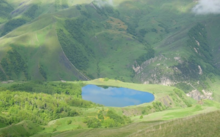
- Galain-Am
- Melhun, the fallen angel.
- Nart, a mythical race of giants. Separately from the mythology of other peoples of the Caucasus, in Waynakh mythology Narts could be both good and evil.
- Almas, evil forest spirits. They can be both male and female almases. Almas-men covered with hair, a terrible kind, fierce and insidious; on the chest of them is a sharp axe. Female almases have an extraordinary beauty, but also evil, insidious and dangerous. Sometimes they seem terrifying creatures of enormous growth with huge breasts, thrown over his shoulders behind his back. Favorite theirs occupation - dance: throwing his chest behind his back, raising his hands up, they dance in the moonlight. Almases live in the woods, on the highlands. They are patronized by wild animals and sometimes come with a hunter in a love affair. Luck on hunting, according to legends, depends on the benevolence of an almas.[12]
- Ghamsilg (or Gham-stag) was a witch who could leave her body and enter into an animal. If in her absence to turn the body, then, on his return from travels, it will not be able to return to his body and dies.
- Djinim (Jinn). In perceptions of Chechens and Ingush good and evil spirits are between angels and devils. Good and evil djinim together are in the same hostility as angels with devils. Through deceit or eavesdropping, they steal the innermost secrets of the future of man and tell their friends of the earth. Falling star - a star angels cast during eavesdropping. Contact with a djinim leads to insanity.[12]
- Taram, invisible guardian spirits that protect his master from all sorts of disasters. On representations of the Nakhs, every person, every household (family), all natural objects had a Taram.[12]
- Uburs, the evil, bloodthirsty spirits, entered into any animal. Close to the vampire in Slavic mythology (cf. Polish: upiór, Ukrainian: upir).[12]
- Hunsag (or Hunstag), the patron spirit of the forest and forest animals. Hunsag seek to destroy every hunter, who met with him in the woods. From his breast sticks out the bone axe. The forest animals, birds, trees, grass rise to defend Hunsag.[12]
- Batiga-Shertko a special figure with the ability to cross over to the underworld to inform a client of how deceased loved ones were doing there, often with an animal sacrifice as payment. The animal was believed to come into the possession of the deceased loved one.[18]


Comments
Post a Comment